Monday, July 20, 2015
Book review
Have read five novels since being away. Two were dull but enjoyable. 'Between, Georgia' was better. The independently published novel I read was a somewhat disturbing story, but the best book by a long way was 'Harvest of Rubies' by Tessa Afshar. This was a good story, not too mushy, and encouraging to my faith. Well worth a read.
Saturday, July 18, 2015
Sylvia Grinnell Park Day
Today there were special activities in Sylvia Grinnell Park. We managed to be there for the free food, as usual! Mind you we stick to the cooked food. There was uncooked Arctic Char on offer. Also I am very, very pleased to at last have got a picture of wildlife.
 |
| The remains of an Arctic Char and the knife used to cut it, lying on cardboard on the floor. |
 |
| Gulliq - the special lamp used in the winter. The wick is along the front right edge and the fuel is animal fat. |
 |
| Red-throated loons. So pleased with these two photos. Beautiful birds and very rare at home. I have only seen them here. |
 |
| Red-throated loons taking flight. |
Polar Bear Frenzy
Well it has been an exciting few days! Turns out the first Polar Bear was shot on the ice
outside the Bishop’s house. He and Karen were totally unaware and rather
disappointed they had missed seeing the bear alive so close and about 6am.
Thursday
morning we heard at least one more polar bear had been seen and possibly shot. The story goes that a parishioner here had rung the Royal Canadian Mounted Police to report seeing the bear. When asked where the bear was now she replied 'In your car park!' So after lunch we headed out to the breakwater to see if we could see the
second polar bear who had sauntered through town. We scanned the ice along with
others, for about thirty minutes, but could see nothing. Wildlife officers
turned up with guns, looking grumpy. But they obviously didn't know where
exactly the bear was either. Then we headed round to the other side of the bay,
passing on the way another couple of wildlife officers with guns. Unfortunately
we had just missed seeing a pod of Beluga whales. However the Beluga Whale
hunters that I chatted to assured me there would be plenty more over the next
few weeks. They suggested we return for another look at 7pm for high tide. I
did see some seals though.
After tea we decided to head back over as the sun
was shining. We saw one solitary seal. However we bumped into the Beluga
hunters again who said the Belugas were at the headland along with more
hunters. As I didn't really want to see whales being shot we headed home.
However not before one of the hunters told me that when he visited Marineland, a marine zoo, at Niagara Falls he salivated at the site of the Belugas there!!!! The
weather and scenery were beautiful though and we had a great day. Sadly not so
the Polar bears. We are currently a bear free zone as the third one was
apparently shot last night. And eaten. Raw.
 |
| The ice in the bay is slowly breaking up. |
 |
| Looking from the causeway towards town - St Jude's Cathedral is in the centre. We are staying in the green building to the left of the Cathedral. |
Tuesday, July 14, 2015
Polar Bear Hunt!?
Well this morning we were told that a Polar Bear was sighted near the town,
down near the dump and where the sled dogs are kept. We wondered if it was a wind-up of newbies but the local community Facebook page confirmed this and added that it had been chased away from the town to islands beyond the mouth of the
Sylvia Grinnell River. Of course we got in the car to go and have a look. We
found a lovely viewpoint near the satellite dishes and I took some photos as we
scanned the river for signs of movement. Of course we didn't see anything but
we spoke to some official looking people who confirmed its movements. The idea
that we could go looking for the possibility of seeing a polar bear is pretty
amazing.
I still have seen precious little wildlife – my bird list is five
species long and we have seen no mammals. Probably in part due to poor weather,
the ice in the bay and the likelihood of any animal worth eating being hunted by humans. For
perspective, when we were in the retreat centre in June in just two days I put
five bird species on my list, gave up on trying to identify others and saw at
least four types of animal. We have now been here three weeks and five days. Below are photos I took today.
 |
| Three of the many dogs in the sled dog area. |
 |
| A sled dog. |
 |
| View of the hills. |
 |
| At the mouth of Sylvia Grinnell River. |
 |
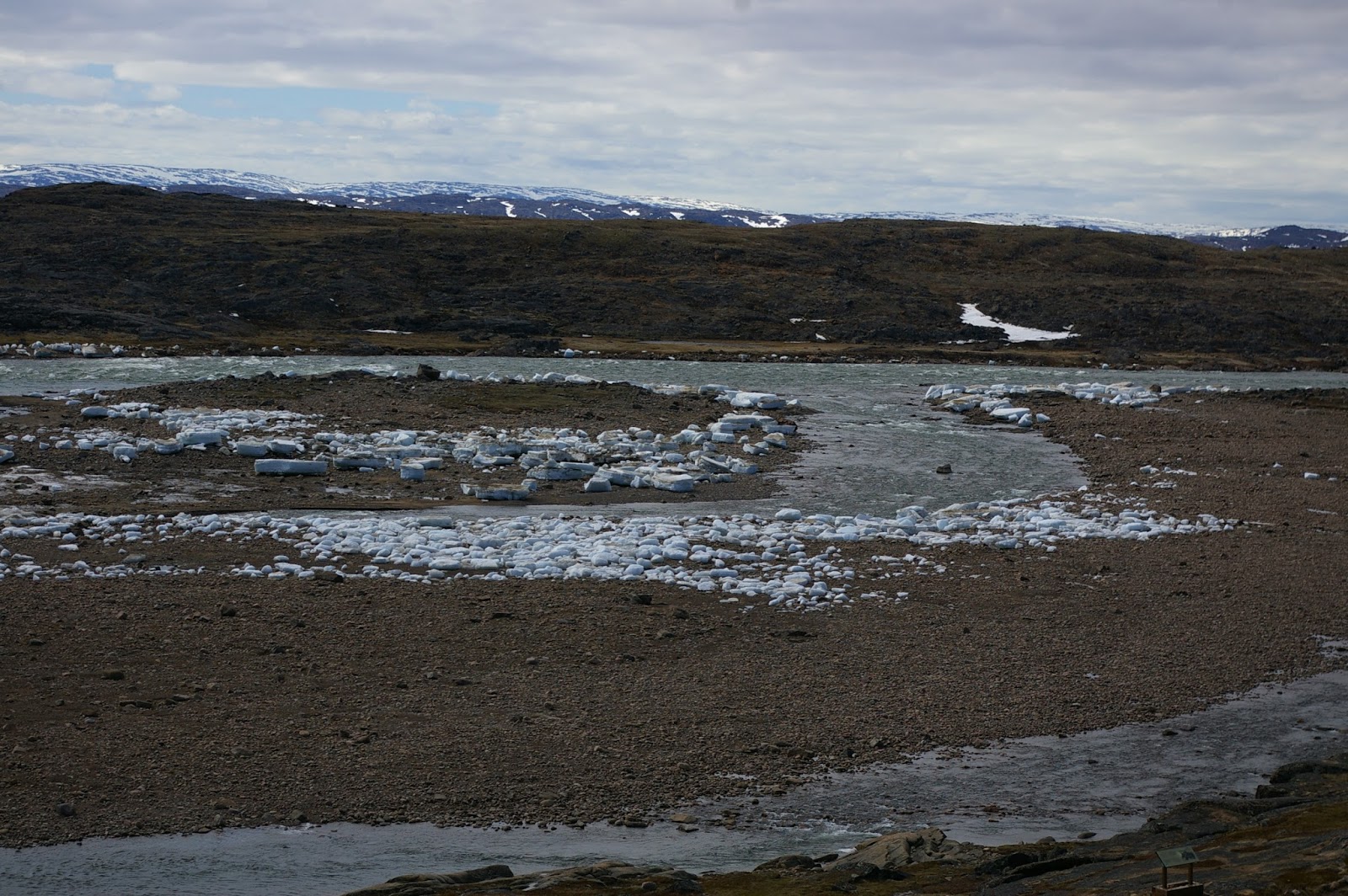
| Some of the last ice on the river. |
 |
| One side of Sylvia Grinnell Falls. |
 |
| The other part of the Falls. |
 |
| An Inushuk - pile of stones telling others where good hunting is to be found or food is stored. |
 |
| Mouth of the river. |
 |
| Fisherman on the river. |
 |
| The tiny flowers of Moss-Campion. |
 |
| Looking north and up river. |
 |
| The river mouth. |
 |
| Islands in the river mouth. |
 |
| The full width of Sylvia Grinnell Falls. |
 |
| Looking up river. |
 |
| A few satellite dishes of the many around and in the town. |

Sunday, July 12, 2015
Meeting gracious servants
We visited an old couple yesterday who we had met at Church, Mike and Margaret Gardiner. The 1st Sunday after we had arrived was Father's Day and Mike had led the service with great vigour and enthusiasm. He is 84 years young and he and Margaret have been in the Canadian Arctic for 60 years. Margaret's physical health is not great, she uses a wheel-chair, and her memory isn't what it once was.
As a boy at school at the age of 12 he had heard a presentation about missionaries and felt he might do that. But he said to God that he didn't like heat so could he go somewhere cold! He went to University and then trained for ministry and was sent directly to the Arctic without firstly being an assistant anywhere. The bishop said that serving firstly in the UK would distort his thinking and that he needed to get directly into the field. He had met Margaret during his training but they weren't allowed to marry until they had come here to ensure she wanted to stay so at the age of 24, in 1955, he was ordained and sent to Kimmurit, a trading post 75 miles south of where we are staying, a journey by sea from England to Canada and then 3 planes and a boat. Margaret travelled to another community Pang some 120 miles north of us where she worked as a cook in the hospital for the one year.
He arrived in Kimmurit and despite having no knowledge of the local language, Inuktitut, apart from a rudimentary idea of the syllabic alphabet, on the 1st Sunday he had to lead a service and preach in Inuktitut. They had no language school, no Wycliffe bible translators support, no phones, no computers. Yet they accomplished it by sheer hard work, the same strength of character they saw in the local Inuit people.
Mike and Margaret were married a year later on a ship in the harbour we look out on from our window as there was no church here in Iqaluit at that time.
Kimmurit was a trading station so a small number of Inuit lived there to hunt for the whites who lived there but mostly the Inuit came in from their hunting camps only to sell pelts. Mike travelled out to their camps by Dog Sled to care for their spiritual needs and had Sunday services for those who resided locally.
They subsequently served in other communities in Cape Dorset, Pang and finally here in Iqaluit for 11 years before retirement. Their 3 daughters all live in the Arctic. One of their daughters and her family live in the High Arctic in Grise Fiord, one of the coldest inhabited civilian communities in the world, with an average temperature of -16.5C and a recorded lowest temperate of -62.2C.
Mike and Margaret are such gentle, humble people. It is hard to fathom how and why they did what they did. He is from Runnymede in Surrey and Margaret is from Birmingham. Yet they travelled and lived in the wilderness for the sake of communicating God's love and care to the people here.
When I get up to speak and see them sitting in the congregation I think what can I say that they don't know better. It makes it clearer that we have a model of learning, even in church, which is about imparting information. Real learning, however, comes from lived experience. They shared what they had experienced of the love of God. They recognised that they were recipients of God's grace and they wanted others to know that same grace for themselves. Even today that is what they communicate in their hospitality and demeanour, even in the very tone with which they speak.
I feel my inadequacy here and yet I am trying to share something of my lived experience of following Jesus and of being known by God. I am searching for what I have truly learnt, not just in my head but in my heart, and I am trusting that people will sense God's grace to them and love for them.
Blessings,
Mike
As a boy at school at the age of 12 he had heard a presentation about missionaries and felt he might do that. But he said to God that he didn't like heat so could he go somewhere cold! He went to University and then trained for ministry and was sent directly to the Arctic without firstly being an assistant anywhere. The bishop said that serving firstly in the UK would distort his thinking and that he needed to get directly into the field. He had met Margaret during his training but they weren't allowed to marry until they had come here to ensure she wanted to stay so at the age of 24, in 1955, he was ordained and sent to Kimmurit, a trading post 75 miles south of where we are staying, a journey by sea from England to Canada and then 3 planes and a boat. Margaret travelled to another community Pang some 120 miles north of us where she worked as a cook in the hospital for the one year.
He arrived in Kimmurit and despite having no knowledge of the local language, Inuktitut, apart from a rudimentary idea of the syllabic alphabet, on the 1st Sunday he had to lead a service and preach in Inuktitut. They had no language school, no Wycliffe bible translators support, no phones, no computers. Yet they accomplished it by sheer hard work, the same strength of character they saw in the local Inuit people.
Mike and Margaret were married a year later on a ship in the harbour we look out on from our window as there was no church here in Iqaluit at that time.
Kimmurit was a trading station so a small number of Inuit lived there to hunt for the whites who lived there but mostly the Inuit came in from their hunting camps only to sell pelts. Mike travelled out to their camps by Dog Sled to care for their spiritual needs and had Sunday services for those who resided locally.
They subsequently served in other communities in Cape Dorset, Pang and finally here in Iqaluit for 11 years before retirement. Their 3 daughters all live in the Arctic. One of their daughters and her family live in the High Arctic in Grise Fiord, one of the coldest inhabited civilian communities in the world, with an average temperature of -16.5C and a recorded lowest temperate of -62.2C.
Mike and Margaret are such gentle, humble people. It is hard to fathom how and why they did what they did. He is from Runnymede in Surrey and Margaret is from Birmingham. Yet they travelled and lived in the wilderness for the sake of communicating God's love and care to the people here.
When I get up to speak and see them sitting in the congregation I think what can I say that they don't know better. It makes it clearer that we have a model of learning, even in church, which is about imparting information. Real learning, however, comes from lived experience. They shared what they had experienced of the love of God. They recognised that they were recipients of God's grace and they wanted others to know that same grace for themselves. Even today that is what they communicate in their hospitality and demeanour, even in the very tone with which they speak.
I feel my inadequacy here and yet I am trying to share something of my lived experience of following Jesus and of being known by God. I am searching for what I have truly learnt, not just in my head but in my heart, and I am trusting that people will sense God's grace to them and love for them.
Blessings,
Mike
Friday, July 10, 2015
Thoughts on Nunavut Day
Hi everyone,
I have been very touched to hear of different people, who I
didn't expect to be interested who are reading the blog. Hopefully this piece
won’t be too disjointed, but I think it will be a lot of different thoughts and
impressions from the last week or so.
Well it is still raining – this is day 8 of serious rain.
There was a short break on Wednesday and it was lovely, but it is raining again
today. Plus it has been very misty and foggy with very poor visibility. And the
roads are washing away. The potholes are increasing in both size and number. It
is lovely driving on the few tarmac roads. Our friend, Samesi, is waiting
patiently for his wife to fly back in, but she has been delayed since Sunday.
She is flying standby, which has made it harder, but the thick fog is making it
difficult for planes to land. The supermarket is beginning to show the strain
in a reduction of the fresh fruit and veg on sale. There were only three punnets
of tomatoes yesterday, no cucumbers and large sections of empty shelves. I didn't
buy the tomatoes as they were in plastic punnets. There is no recycling here
and Mike is planning to take a load of recycling back in his spare suitcase to
recycle at Ottawa airport (I kid you not).
Back to the airport and Karen’s brother and family are due to arrive
tomorrow. I am sure she is very concerned about the likelihood of their
arrival. If you want me home on time (hint, hint family) please pray there is
good weather on 2nd August up here. When I look at the local weather
forecast, as observed at the airport, and look at the seven day forecast, after
about the third day, I think the forecast is based on history. Days four
through seven are always more optimistic than what actually happens.
The bay is still frozen over and no boats are able to sail.
Although there is now a small band of open water across the bay and the ice is
getting darker (a sign that it is becoming water-logged), the ice-breaker ships
are still unable to get in. Usually the bay melts in mid-June. People here are
waiting for the sea-lift to bring in supplies. Many people order enough dry
goods to do them a year and then these supplies are shipped in during the
summer. Apparently it is a lot cheaper to do this. For two adults and two under
fives the supplies needed are about $8000. This obviously makes it difficult
for those struggling financially to benefit from the sea lift as one needs
spare income in order to save for it. Building supplies also come in by ship in
the summer. There is no deep harbour here, so I understand goods come in off
the ships by barge. I look forward to observing this – hopefully I get the
chance and the bay does melt.
Yesterday was Nunavut day and we went to the celebrations
(moved to the high school due to the weather). We had a cooked beef burger, but
elsewhere we could see raw meat and fish being served to the Inuit population, a country feast as they call it.
I saw one paper plate piled high with raw stuff – I mean it didn’t look like
meat as we know it. It looked like thick red jelly or white jelly. Some was
probably fat and some maybe offal. I think I may have seen whale meat too.
Later we went to the cinema to see a couple of Inuit
documentaries. They had English subtitles. Watching any film based on Inuit
history is pretty intense as they have suffered so much injustice. The Canadian
government moved people about by force to use the Inuit population as a way of
securing Canada’s high northern territories from other countries – presumably the
Russians, USA and China – as the high north has many mineral and oil reserves.
Also over a twenty year period the RCMP slaughtered thousands of dogs to
prevent the Inuit people from moving around. It was a bit like the government
taking away our cars and our access to food as the dogs also helped with
hunting. Since the establishment of the territory of Nunavut, there does seem
to be an element of healing taking place. However the mix between a settled
life in the towns and a nomadic lifestyle of hunting and fishing seems to be a
difficult balance. The Canadian government still needs the help of the Inuit
people to secure the northern lands, but they are not willing to spend the
money on health and social care that would enable the Inuit population to
thrive. While the Anglican church is mostly serving the Inuit population up
here, there is still anger at how the churches helped the government in the
past to try and wipe out Inuit culture. However Christianity seems surprisingly
welcome and prevalent among the Inuit population. While Inuit and Westerner do
mix here and intermarry to an extent, it is hard to describe the clash of
cultures here. The Inuit still want to live off the land and maintain their
culture. The Canadian government want to educate people in a Western style and
develop the natural resources and protect their ‘borders’.
Iqaluit is a very
unique place. We have been given a great welcome here by both Inuit and
Westerner. Canada itself is a strange place because Canada has welcomed many
nationalities as citizens, however Iqaluit leaves me feeling that where I
belong is back home in Northern Ireland with all its faults and failings. Just
confirming what I have always felt really. I am glad though that I do belong
somewhere as many westerners here do seem to be looking for a sense of
belonging. Many come to Iqaluit and enjoy the welcome and the small community,
but then leave again due to the harsh weather. Others stay many years. Some who
have been here many years then retire ‘south’, possibly due to cost of living
or links to family in the ‘south’. I hope that is a fair representation.
I will sign off for now as my stomach is telling me that it
is time for lunch – no raw meat! J
Love, Sarah
Monday, July 6, 2015
Sylvia Grinnell National Park
Hi all, The weather has been miserable since Friday - rain and mist. Today is dry so far but it is the coldest day yet. We plan to go for a run later, but it feels too cold to do much else. We helped out at the soup kitchen because they were short staffed today. However last Thursday we took a taxi out to Sylvia Grinnell Park and had a lovely afternoon. So here are the photos I took then. Love to everyone and thanks for your prayers, Sarah.




Subscribe to:
Posts (Atom)